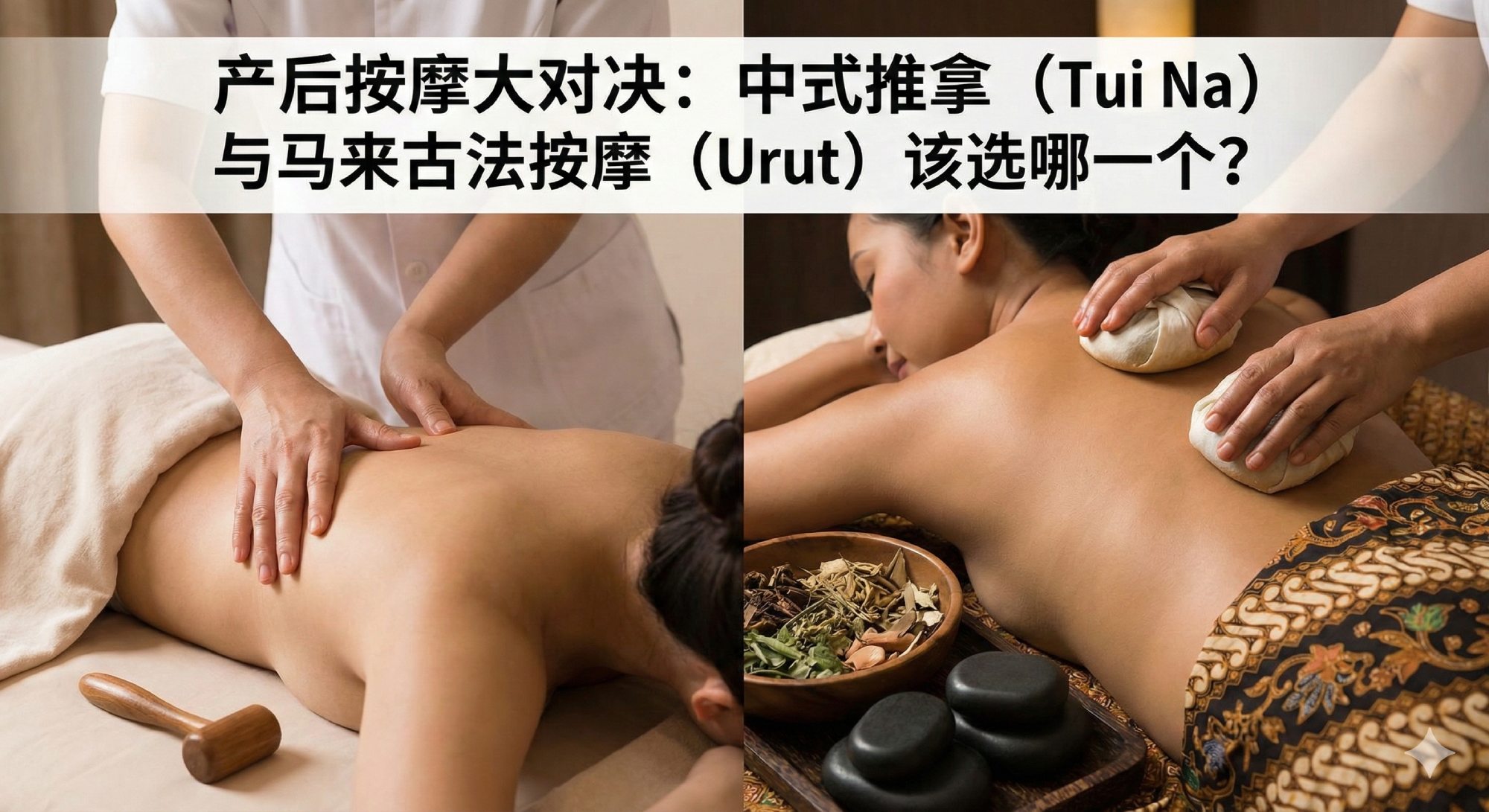
Staring at the menu of postnatal massage services, wondering whether to book Tui Na or Urut? You are not alone. For Malaysian new moms, this decision feels overwhelming—especially when every auntie has a different opinion.
Here is the truth: both Chinese and Malay postnatal massage traditions have healed generations of mothers. But they work differently. Choosing the right one (or combining both) depends on your body, your delivery, and your recovery goals.
In this guide, we break down everything—techniques, benefits, rituals, and price ranges—so you can make the best choice for your postnatal massage in Malaysia.
Quick Comparison: Tui Na vs Urut at a Glance
| Feature | Chinese Tui Na (推拿) | Malay Urut Pantang |
|---|---|---|
| Main Focus | Pain relief, expelling “wind,” muscle recovery | Lactation support, womb repositioning, body shaping |
| Technique | Deep acupressure on meridian points | Long, rhythmic strokes with herbal oils |
| Pressure Level | Firm to intense (deep tissue) | Moderate to firm (relaxing) |
| Special Rituals | Ginger oil application, meridian stimulation | Sengkak (womb lifting), Bertungku (hot stone), Bengkung binding |
| Best For | Back pain, joint stiffness, C-section recovery | Breastfeeding moms, womb recovery, waist slimming |
| Typical Price (KL/PJ) | RM150–300 per session | RM180–350 per session |
Traditional Malay Massage (Urut Pantang): The Holistic Healer
Urut Pantang is more than a massage—it is a full postpartum wellness system passed down through Malay midwives (bidan) for centuries.
The Technique: Rhythmic & Relaxing
Using thumbs, palms, and forearms, the therapist applies long, flowing strokes with warmed herbal oils (often lemongrass or ginger-infused). The pressure is firm but soothing—designed to:
- Improve blood circulation
- Stimulate lymphatic drainage
- Release “angin” (wind) from the body
- Relax tense muscles from labor
The Lactation Advantage: Urut Payudara
Here is where Malay massage truly shines for breastfeeding moms. Therapists perform Urut Payudara—specialized breast and underarm massage that:
- Clears blocked milk ducts
- Relieves engorgement pain
- Stimulates milk production
- Drains lymph nodes to prevent mastitis
If you are struggling with low milk supply or frequent clogged ducts, this alone makes Urut worth considering.
Unique Rituals: Sengkak & Bertungku
Sengkak (Womb Lifting): A gentle but specific technique where the therapist uses controlled pressure to guide the uterus back to its pre-pregnancy position. This helps with:
- Faster uterine involution
- Reduced postpartum bleeding
- Better pelvic floor recovery
Bertungku (Hot Stone Therapy): A heated river stone wrapped in medicinal leaves is pressed along the abdomen and back. Benefits include:
- Breaking down residual fat deposits
- Expelling “cold wind” from the body
- Improving circulation to healing tissues
Bengkung Binding: Post-massage, your abdomen is wrapped tightly with a long cotton cloth. This traditional corset:
- Supports the pelvic floor
- Helps diastasis recti recovery
- Reshapes the waistline naturally
Traditional Chinese Massage (Tui Na): The Precision Fixer
Tui Na (pronounced “twee nah”) comes from Traditional Chinese Medicine (TCM) principles. It views postpartum recovery as restoring balance to the body’s energy flow (Qi) and blood circulation.
The Technique: Targeted & Therapeutic
Unlike the flowing strokes of Urut, Tui Na uses:
- Thumb and finger pressure on specific acupoints
- Elbow techniques for deeper muscle release
- Meridian line stimulation to unblock energy pathways
The pressure is typically more intense—digging into knots and tension points rather than gliding over them.
Focus: Pain Relief & “Wind” Expulsion
TCM theory says childbirth leaves the body vulnerable to “Wind-Dampness”—a condition causing:
- Chronic back pain
- Stiff joints and muscle tension
- Sensitivity to cold and drafts
- Persistent body aches
Tui Na directly addresses these issues by:
- Stimulating blood flow to injured tissues
- Releasing deep muscle tension
- Warming the body from within using ginger oil
- Restoring proper alignment
If you left the hospital with severe back pain or feel like your body “never recovered” from labor, Tui Na may provide the deep tissue relief you need.
Post-C-Section Considerations
Many Chinese massage therapists have specific protocols for Caesarean recovery, focusing on:
- Scar tissue mobilization (after healing)
- Abdominal muscle reconnection
- Improving digestion and bloating
Which Postnatal Massage Should YOU Choose?
Still torn? Here is a simple decision framework based on your biggest postpartum concerns:
Choose Malay Urut If:
- ✅ You are breastfeeding and need lactation support
- ✅ You want womb repositioning (Sengkak)
- ✅ Waist slimming/body shaping is a priority
- ✅ You prefer a relaxing, oil-based massage
- ✅ You love traditional hot stone (Bertungku) therapy
Choose Chinese Tui Na If:
- ✅ You have severe back/joint pain from pregnancy
- ✅ You feel “cold” or have wind sensitivity
- ✅ You want deep tissue work for muscle knots
- ✅ You had a C-section and need scar recovery
- ✅ You prefer acupressure over oil massage
Can You Combine Both? The Fusion Approach
Yes—and many Malaysian moms do!
Modern confinement centers and mobile massage services now offer fusion packages that blend the best of both traditions:
- Start with Tui Na to fix back pain and muscle tension
- Follow with Urut for breast care and womb lifting
- End with Bengkung binding for support
Talk to your therapist about your specific needs. Many are cross-trained in both techniques and can customize your session.
Frequently Asked Questions (FAQ)
When can I start postnatal massage?
For natural birth: As early as 3–5 days postpartum, once bleeding stabilizes.
For C-section: Wait 4–6 weeks until the incision is fully healed. Always get clearance from your doctor first.
How many sessions do I need?
Traditional confinement massage packages typically include 7–10 sessions over 2–4 weeks. For specific issues like back pain or low milk supply, 3–5 targeted sessions may suffice.
Is postnatal massage painful?
Malay Urut is generally relaxing with moderate pressure. Chinese Tui Na can be intense—especially on sore spots—but should not be unbearable. Always communicate with your therapist about pressure preferences.
Can I do postnatal massage if I am not breastfeeding?
Absolutely! Both Tui Na and Urut offer benefits beyond lactation—womb recovery, pain relief, and emotional wellness apply to all new mothers.
How much does postnatal massage cost in Malaysia?
Prices vary by location and experience:
- Mobile/home service: RM180–350 per session
- Confinement centers: Often included in packages
- 7-session package: RM1,200–2,500
What should I avoid after postnatal massage?
- ❌ Cold drinks or showering immediately after
- ❌ Heavy lifting or strenuous exercise
- ❌ Sexual intercourse for at least 2 weeks
- ✅ Do drink warm water and rest
Final Thoughts: Listen to Your Body
There is no “wrong” choice between Tui Na and Urut. Both traditions have stood the test of time because they work.
The best postnatal massage is the one that addresses your recovery needs—whether that is fixing your aching back, boosting your milk supply, or simply giving yourself permission to rest and heal.
Our advice? If you can, try both. Start with one tradition for a few sessions, then switch. Notice how your body responds. The goal is not perfection—it is recovery, one massage at a time.
Have you tried Tui Na or Urut? Which worked better for your recovery? Share your experience in the comments below—we would love to hear from you!

